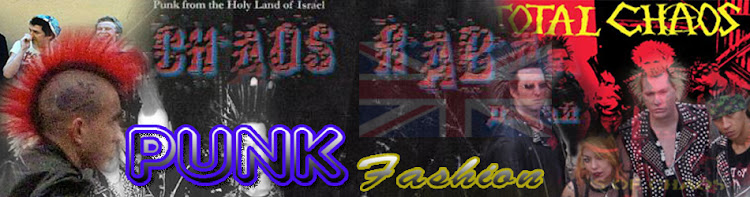
Punk bands, eschewing the perceived excesses of mainstream 1970s rock, created short, fast, hard music, with stripped-down instrumentation and often political or nihilistic lyrics. The associated punk subculture expresses youthful rebellion, distinctive clothing styles, a variety of anti-authoritarian ideologies, and a DIY (do it yourself) attitude.
Punk rock became a major phenomenon in the
Wednesday, February 27, 2008
What is punk

Saturday, February 16, 2008
History of Punk Rock
A Brief History of Punk
The Foundations of Punk Rock
The beginnings of punk rock are often furiously debated. This is partially because everyone has different definition of punk rock, and partially because its foundation stones are found in several places.
"Punk Rock" was originally used to describe the garage musicians of the '60's. Bands like the Sonics were starting up and playing out with no musical or vocal instruction, and often limited skill. Because they didn't know the rules of music, they were able to break the rules.
The mid to late '60s saw the appearance of the Stooges and the MC5 in
The Velvet Underground is the next piece in the puzzle. The Velvet Underground, managed by Andy Warhol, were producing music that often bordered on noise. They were expanding the definitions of music without even realizing it.
The final primary influence is found in the foundations of Glam Rock. Artists like David Bowie and the New York Dolls were dressing outrageously, living extravagantly and producing loud trashy rock and roll. Glam would end up splitting up its influence, doling out portions to hard rock, "hair metal" and punk rock.
The first concrete punk rock scene appeared in the mid '70s in
The bands were unified by their location, camaraderie, and shared musical influences. They would all go on to develop their own styles and many would shift away from punk rock.
While the
Meanwhile, Across the Pond
This is where the beginnings of punk fashion as we know it emerged, and they centered out of one shop. The shop was simply called SEX, and it was owned by Malcolm McClaren.
Malcolm McClaren had recently returned to
Enter The Bromley Contingent
Among the fans of the Sex Pistols was an outrageous bunch of young punks known as the Bromley Contingent. Named after the neighborhood they all came from, they were at the first Sex Pistols shows, and quickly realized they could do it themselves.
Within a year, the Bromleys had formed a large portion of the London Punk scene, including The Clash, The Slits, Siouxsie & the Banshees, Generation X (fronted by a young Billy Idol) and X-Ray Spex. The British punk scene was now in full swing.
The Punk Rock Explosion
By the late '70s, punk had finished its beginning and had emerged as a solid musical force. With its rise in popularity, punk began to split into numerous sub-genres. New musicians embraced the DIY movement and began to create their own individual scenes with specific sounds.
In order to better see the evolution of punk, check out all of the subgenres that punk split off into. It's a list that's constantly evolving, and it's only a matter of time before more categories appear.
Source : http://punkmusic.about.com
Read MoreThe Mutated Child of Punk
Industrial subculture was born as a mutated and futuristic form of punk style. It has inherited many aspects of punk style, but has also updated them to be more modern and futuristic. Every aspect of both subcultures converges to one main point: chaos, and both subcultures find their greatest joy in flaunting that chaos and lack of control. Punk represents this chaos in the near past and industrial subculture is a continuation of that chaos in the future. It is a future that we are on the verge of discovering, but at the same time remains dark and foreboding. It is a future that is filled with an excess of technology and a lack of morals. It is a future where machines have more communication between each other than human beings do. Each aspect of each culture illustrates this connection in a unique way, but fashion and music stand out as particularly strong areas for semiotic analysis of the various signs that characterize and typify each group
Hebdige says that through semiotics, everything a person wears, does, says, etc., can be viewed as a sign, and that all of those signs together can be analyzed to obtain an accurate representation of who a person is and why they portray themselves the way that they do. Of the conscious and subconscious choices made everyday, Hebdige says that the total effect "gives itself to be read" (101). Hebdige's basic idea is that through the use of semiotics we can recognize these signs and evaluate what they mean. For punk and industrial subculture, it is a very conscious choice of dissension. Before we can understand that choice of dissension, we must first exam and define society's norms. Hebdige says that society's norms "are distinguished by their relative invisibility, their appropriateness, their naturalness'" (101). The norms in society are what we fail to notice everyday because of their invisibility.' It is both because of their appropriateness' and their naturalness' that when we are surrounded by the poster children of Gap and Abercrombie and Fitch we dismiss them without so much as a second glance. Society's norms are represented in those poster children, and punk and industrial subcultures consciously chose not to be a part of that stereotype.
Punk music is characterized by screeching vocals, distorted instruments, and explicit use of foul language. Punk used this wide variety of crashing and destruction to create a surreal effect that emphasizes different elements of chaos. Hebdige describes punk musical style as "relentless (un)melodic lines against a turbulent background of cacophonous drumming and screamed vocals" (109). Describing punk music, Johnny Rotten said, "We're into chaos not music" (109). There is a certain anger and angst that goes side by side with punk music which, according to Hebdige, "reflected the tendency towards willful desecration and the voluntary assumption of outcast status" (110). Punks were proud to be who they were. They were proud to be viewed as outcasts in society, partly because of what that society represented to them, and perhaps partly because of the attention that it brought to them. Punks were trapped in a society that they wanted no part of. They had no desire to belong to a world ruled by hypocrisy and janus faced politics. They escaped through their music. The Sex Pistols, the Clash, the Unwanted, and hundreds of others were their saviors.
Industrial subculture is entirely synonymous. Many of the same elements can be seen in industrial music as in punk music. The most obvious of these is the anger. Anger and dissatisfaction are two key elements in much of industrial music. The actual rhythms in industrial musical style, like punk, tend to be loud, and fast. Another interesting component of both punk and industrial music is the use of abnormal sounds to create surreal effects. For instance, both punk and industrial style bring in elements to their music that contemporary styles would not. Industrial music in particular makes use of an extreme amount of sampled audio. Industrial music samples everything from screaming to audio taken from science fiction and cult movies to gunshots resulting in a more surreal atmosphere. This surreal effect also creates a certain kind of chaos that is on par with the chaos created by the punk style of music. Industrial music's strong focus on sampled audio is another reminder of the subculture's strong ties with a disjoined, technological future.
Just as the actual mechanics of the industrial musical style strongly emphasize chaos and disorder the lyrics emphasize this same chaos and disorder to an even greater extent. In his industrial anthem, Capital Punishment, famous industrial musician Rudy Ratzinger rasps "Capital punishment for me, capital punishment for I have sinned. Capital punishment for me, capital punishment for I was wrong." He expresses a certain willingness to be punished, because he is fully aware of what he has done. He is aware of the rules that he has broken and he is similarly aware of their resulting consequences. Rudy admits that he "has sinned" and is very proud of it. He is proud of his actions and faces his punishment as if it were an honor. Industrial subculture and punk subculture have certainly both broken many rules, and have been forced to face many consequences of those broken rules. The members of industrial and punk subculture have treated their punishment just like Rudy. They know that they must face their punishment for the "sins" that they have committed, and they face it proud of what they have done.
Punk fashion similarly emphasizes chaos. Mismatched plaids and ripped school uniforms are commonplace. Hebdige reports "lavatory chains were draped in graceful arcs across chests encased in plastic bin-liners" (107). Punk subculture stole what society as a whole deemed to be void of meaning and filled that void with their chaos. They empowered themselves with a certain feeling of control by being able to take what was not theirs and turn it into something that was distinctly their own. They replaced an emptiness of value with their twisted views of society and anger, and after they had stolen those symbols they proudly flaunted them by covering their bodies with them and parading them around in a living protest of society's norms.
Punk fashion also demonstrates a strong tendency towards fetishism. From bondage pants, clothing adorned with used condoms, to rusty medals of masochism pinned through eyebrows and lips, punk fetish fashion was anything but vanilla sex. Hebdige says:
Rapist masks and rubber wear, leather bodices and fishnet stockings, implausibly pointed stiletto heeled shoes, the whole paraphernalia of bondage the belts, straps and chains were exhumed from the boudoir, closet and the pornographic film and placed on the street where they retained their forbidden connotations.
The recurring theme of chaos is not absent from this fashion statement. Punk fashion took what society was not willing to talk about and shoved it in society's face. They forced society to rethink and reevaluate their moral stances by forcing people to feel awkward and embarrassed.
Industrial fashion is a reflection of the punk style but twisted to the same darker more futuristic time frame that is the basic characteristic of industrial subculture. The same chaos is clearly evident in the small pale faces and tattered black clothes of the industrial subculture. The carefully applied black and blood red shades of lipstick as well as the massive amounts of black eyeliner running circles around blood shot eyes are all semiotic signs of a desire to stand out from the norm by being more dangerous and more chaotic and out of control than society's standards. When society said, "less is more", punk and industrial turned around and said, "no, more is more." Common practice in many subcultures is the achievement of power through the ability to alter and modify an individual's appearance, and industrial and punk subcultures are no exceptions.
However industrial subculture has taken the punk's fetishism to an even more extreme level. Eighteen inch black vinyl corsets and tight black chokers, thigh-high vinyl boots and clothing adorned with hypodermic needles, ritual body scarification and tattoo, all flaunt the chaos of the industrial subculture. They all show how out of control each member is, and how each member takes pride in that lack of control. In a sense, the chaos comes from giving in to desires that society has frowned upon and forced to be repressed. Fetish fashion, whether punk or industrial, allows the wearer to transcend those societal boundaries and become the antithesis of society's accepted values and norms. It is the ultimate revolt from society's conformist poster children wrapped in Gap and Hilfiger.
What is the future of this mutated child of punk? Today, the punk movement is still alive after several decades of major changes in the world. Will the industrial subculture prove to be as durable, or will the parent outlive the child? What will the children of industrial subculture be like? If examining industrial subculture as a futuristic child of punk subculture has revealed anything at all, it has revealed how strong the thread of chaos is. It weaves itself through out both industrial and punk music, fashion, fetishism, dancing, and countless other aspects of subculture, and ultimately is the bond that brings them all together and unifies them. If one thing is certain it is that the future will undoubtedly be a future that is tightly tied together by the interweaving threads of chaos.
Source: http://project.cyberpunk.ru
Read MoreThe popular misperception
It was here in 1975, among the Hell's Angels, wino's, junkies, and prostitutes that bands such as the Talking Heads, Richard Hell and the Voidoids, the Patti Smith Group, Deborah Harry (Blondie), and the Ramones all launched their careers and reinvented the sound, look, and attitude of rock music for generations to come.
 One of the driving forces behind punk rock, as with most forms of rock music, was rebellion. The general consensus was that the rock and roll industry had become too safe, mainstream, corporate, and therefore no fun. Many of these early punk groups took it upon themselves to express their displeasure with the direction music had taken in the mid-70's and tried make rock dangerous again. Although these attitudes were shared by early punk rock groups, a similar sound was not. Each of these early groups developed their own unique sound that separated them from the others.
The word 'dirty' comes up frequently in a discussion about punk rock. Often this term is a reference to the discordant sounds produced by guitars amplified to the point of feedback, or white noise. "Dirty" could also refer to the lyrical content that is often considered vulgar. But it also has as much to do with the appearance of the practitioners. In this respect it is important to consider the visual aesthetic of punk rock musicians because of the impact these styles had on underground youth culture of the time, and mainstream culture that followed in the 80's and 90's. Additionally, punk rock fashion, an oxymoron to some, signified the movement as a more individualistic, and a reaction to mainstream culture.
In
This was especially true in
These factors contributed to the deeply political overtones that punk embodied once it made its way across the pond.

In addition to the raw musical aggression, punk embraced an almost primitive fashion aesthetic which featured spiky hair, multi-colored mohawks, and ripped t-shirts cleverly held together with safety pins that made their way into the noses, ears and tongues of those eager to push the boundaries of acceptable attire. For many, punk fashion took the gender bending kinkiness of glam rock and injected it with a lethal dose of black leather and gothic barbarism in the form of heavy make-up. The resulting styles were caustic and offensive, however they were also refreshingly inventive, fascinating, and sublimely rebellious.
The abrasive character of punk was as unsettling to hear, as it was to observe for many, however as it has always been viewed with skepticism by mainstream audiences, it has endured to permanently alter the look, sound and attitude of rock music to this day.
Source: http://arted.osu.edu